Chugging, comments and blogging

11:43am, 17th November 2009

It’s occurred to me that I never returned to the comments I removed from the blog during the chugging episode, despite promising that I would either restore them or explain why I removed them.

In fact, I made the decision fairly soon after I removed them that they would not be returning. This was after a few people made some easy suggestions on how I could test my theories.

There were six comments deleted (along with my responses which made no sense on their own) which purported to come from two people. Both were from what I would call ‘disposable’ addresses, in other words webmail accounts that can be set up for free using any name. And all the comments came from the same place, which first aroused my suspicion that it they might be the same person. However, it was that the place in question was a charity that fundraises using chugging, while the commenters said they had no direct interest, that made me decide they would be permanently deleted.

While I’m prepared to accept that two individuals from the same charity independently decided to comment on my blog in defence of chugging I do think they should have stated their involvement with chugging rather than claiming to be “just an interested observer.”

After I suspended the comments one of the accounts was used to accuse me of censorship. Well, it is my blog and it’s up to me what goes on here, but even so there are a number of people who have commented to disagree with me and those comments have been allowed to stay – indeed, there are a number from the PFRA on this very subject and several on my original chugging post whose comments express their dislike of my position (and indeed me). With the exception of spam these are the very first comments I have deleted and I think I have every justification in that course of action.

Clearly anyone who works for a charity that is, at least in part, reliant on chugging will have an interest in defending chugging. We all have interests and prejudices – but we should be open about them. To my mind it’s slightly dishonest to pretend you are an impartial outsider since this adds more credibility to your argument, pretty much whatever the subject. It was because of this, rather than censorship or the fact they were getting a little offensive, that I decided not to reinstate the comments.

However, in the interests of openness I will briefly outline the points made. All I would ask is that you read them aware that they originate from staff at a charity that uses chugging:

  • I was shifty in the interview on the Today programme
  • The PFRA have been entirely honest and straightforward about the issue
  • I am only feigning concern about chugging as a publicity stunt
  • Anyone who opposes chugging prevents essential help getting to the world’s most needy
  • The campaign is solely to further my political career
  • People dislike chuggers because it reminds them of their shared guilt for colonial exploitation and slavery

It was partly because of this series of comments that I stopped blogging about the issue. However, we are continuing to monitor the situation in Wandsworth and are trying to seek a solution. We formally complained to one of the charities in September, copying the complaint to the PFRA, Institute of Fundraising and Fundraising Standards Board, but to date I have had no response from any of them, possibly because of the postal strike.

I’m happy with people of any viewpoint having their say, and would encourage anyone to comment. I do not require any details from you, and while your first comment is moderated (that is, I will read it before it is published) after that any comments are posted immediately. To my mind a blog is not a blog without comments, and those comments can – and should – include debate. If you ever read anything on here that you want to say something about, whether you agree or disagree, please be my guest and say what you want. All I ask is that you are honest and straightforward.

Share this:
  • Print
  • email
  • Digg
  • FriendFeed
  • Facebook
  • del.icio.us
  • Google Bookmarks
  • StumbleUpon
  • Twitter

How fate mocks my arrogance

2:29pm, 8th July 2009

Yesterday I opted out of Iain Dale’s blogging poll. The poll, which he runs every year, produces various top 10 style lists – all of which come with a button that you can use on your blog to advertise your success and link back to his Total Politics site. I reckon I was in with a good shout of placing well in the ‘Conservative Councillors called James’ category.

I would hasten to add I’m not participating in any boycott. While I don’t read his blog or follow him on Twitter I can’t say I share any of the dislike of his politics or personality that seem to motivate some of them. My opinions of him are, well, non-existent.

Instead, I just dislike the rather self-congratulatory nature of these things. They lend themselves to hubris and focus on entirely the wrong aspects of blogging. Over the weekend during some casual surfing, I came across one blogger who, having got hold of a top 100 list in which their blog featured managed to sub-categorise and slice the list to ‘prove’ that they were among the top 10 most influential blogs in the country.

I don’t really want to be part of that.

Yes, it’s nice to know that people appreciate what you are doing. And perhaps if it were a Wandsworth based poll I might think differently. But I’m not blogging to do well in some league table. I’m blogging – primarily – as a councillor. My focus shouldn’t be, and isn’t, on getting Iain Dale’s attention. Instead, it’s here to provide something of a service to residents.

So, feeling smug about my decision fate mocked me when I discovered that Andrew Beeken, the web manager at Lincon City Council, had used me as an example of good practice in a presentation to councillors there. From further conversation, I discovered that I’ve even been cited in Australia.

Flattering, ego-massaging stuff. And fate giving me a ticking off for being pompous earlier.

It might be a bit different being used as an example of how a councillor can engage to featuring in an arbitrary poll but what really matters is that I am, I hope, providing a good service to people in Wandsworth – if I can entertain a little or get a wider readership outside then so much the better.

Which begs the question – which I ask from time to time – is there anything you want to tell me, ask me or berate me about my online engagement? Anything you want to see more of, less of or even nothing of? Something you’d like to see on here that I’m not doing already? Just let me know, because at the end it’s not about me, my ego or arbitrary rankings – it’s about you and how I can better serve you as a councillor.

Feel free to comment, email me at cllr@jamescousins.com or send me an @message on Twitter.

Share this:
  • Print
  • email
  • Digg
  • FriendFeed
  • Facebook
  • del.icio.us
  • Google Bookmarks
  • StumbleUpon
  • Twitter

Tom Watson, buses and digital engagement

1:35pm, 7th July 2009

BusBecause of my blogging, Twittering and dabbling in other things digital-engagement I seem to have fallen in with a crowd who are passionate about the power of social media to change the world. Sadly, I am a cynic, a pessimist who recognises that for all its power, it’s limited.

Limited by the people who use it because for all the Twittering in the world, if you don’t actually do anything, it makes no difference.

And limited by the people who don’t use it. For all the huge numbers bandied around of facebook users and Twitter accounts, the overwhelming majority of people do not use them. Many people just do not access the internet at all, others only for a bit of eBaying or online bingo.

But if we are going to make it all work then the early adopters have a responsibility to use it wisely and show how it can be a force for good.

But this seems to happen so rarely, and brings me to a rant that has been building for a few days. It involves Tom Watson, Sadiq Khan, buses and public spending – and I think an example of how we shouldn’t be using social media.

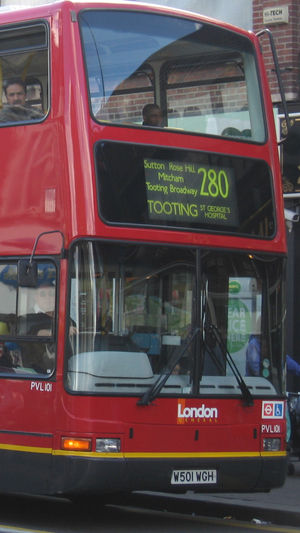
Tom Watson’s name may ring a bell after he got caught up in the Damien McBride smear scandal. However, he is also something of an unlikely poster boy for the advocates of digital engagement. He is one of the most prominent Twitterers in Parliament and a blogger. And last week launched an online petition, aimed at Sadiq Khan – recently appointed a minister of transport (who can attend Cabinet where he can, apparently, watch the Cabinet not talking to each other). The petition asked Khan to “Please sort a ‘where’s my bus?’ mobile app.” The detail suggesting “GPRS technology makes it easy for your mobile phone to tell you where the next bus is. Please sort it out for the UK.”

Why do I think this is a bad example? For a number of reasons.

First, we need to have a real debate in this country about public spending, and the Prime Minister has already announced a “0% rise”. Surely this is something we can really debate and start having some of those discussions online – where everyone can participate.

Petitions, however, are not the way to go. Even as I was highlighting the No. 10 ‘resign’ petition I accepted that petitions push a single issue without regard for the alternative.

Second, which follows on from this, is the cost. According to Bus Zone (the best I could find), there are around 32,000 buses in this country. Back of the envelope calculations: let’s say it’s £100 per bus to fit a GPS unit. That’s £3,200,000 gone. You then need to set up the infrastructure, I can’t even begin to guess the cost of that. But on top of that you have to factor in the running costs. The buses will have to communicate with the centre – so you will effectively have to buy 32,000 air-time contracts year. Even if you got a deal at, say, £10 a month per bus, then you have £3,840,000 a year running costs. Then factor in unit failure, maintenance and replacement…

And these figures are very conservative. The government does not have a great track record of implementing large IT projects – so you can bet it would be more than the £22,000,000 my figures come to for the first five years. Can you think of better ways of spending £22,000,000? I certainly can.

Third, it’s another of those example of pushing a technological solution for a problem that does not really exist. Perhaps if we had a more extreme climate that might make standing at a bus stop for a few minutes a problem. But actually, is waiting a few minutes for a bus such a hardship? Even in those areas where buses are less frequent, timetables exist. Somehow public transport has operated – more or less – successfully for generations without everyone knowing exactly where the next bus is.

Fourth, the people who would benefit most are the people who need it least. Those who have to rely on buses, particularly out of London, are often the less well off who cannot afford the latest mobile phone to track their bus, or are from sections of society who are digitally excluded and would not know what to do even if they wielded the latest iPhone or Nokia.

Fifth, and finally – this is just a bad example of social media campaigning. As I write only 55 people have ’signed’ by re-tweeting the petition, despite Tom Watson having over 4,000 followers.

To make matters worse, Sadiq Khan hasn’t even responded, except to thank Tom Watson “for directing hundreds of people my way.”  No comment on the issue, not even a “I’ll look into it”.

This is disappointing.  If we are to believe social media can give ordinary people power, it has to be something of a blow to our confidence when people who have real power aren’t even getting a 140 character answer.

This is a bit of a rant. But if we are to start getting social media taken seriously as something that can engage and empower people, then it’s for MPs and ministers to start using it properly, on serious issues that will make a difference. There are an infinite number of nice things we can have petitions on, but why not start discussing some of the more fundamental issues and seeing where it goes. You might find people participate while they are waiting for the bus.

Share this:
  • Print
  • email
  • Digg
  • FriendFeed
  • Facebook
  • del.icio.us
  • Google Bookmarks
  • StumbleUpon
  • Twitter

Using my blog to report back…

3:01pm, 29th May 2009

One of the suggestions when I asked for ideas for the blog last week (and I’m still looking for ideas or suggestions, feel free to add a comment or email cllr@jamescousins.com) was a regular ‘report’.  Of course, reports can take many formats, but I thought I’d give it a go.

I’m going to trial this for a few weeks to see how it works.  I will state from the outset that I’m a little sceptical about the value and have some caveats.

The main reason I’m sceptical is because it just cannot be exhaustive.  Using the example of meetings, while I can list the meetings I’ve attending, some are confidential or will have confidential parts.  Indeed, even where those meetings aren’t explicitly confidential I feel that, unless they are public, it would benefit no-one if they felt anything they said would end up on a blog.

Moving on to work in the ward, again, the confidentiality issue rears its head.  Casework often involves highly personal matters that I simply cannot disclose.  Even when dealing with broader issues residents expect a degree of discretion because of concerns about relationships with neighbours, for example.  Earlier this year I privately started mapping my work in the ward but decided it was not suitable for publication because there were so many privacy issues involved.

More fundamentally, there’s the question of what merits inclusion.  To give an example I started the week spending a lot of time working on the launch of our Neighbourhood Watch strategy for next week.  I’ve also spent time trying to organise a meeting for residents of Eccles Road.  While the launch and meeting would probably be reported when they happen, is the preparation of one more worthy of inclusion than the other?  My instinct is to include Neighbourhood Watch because it affects the whole borough, but an Eccles Road resident might well think I’ve made the wrong call!

Above all, I wonder how useful it will be to a Shaftesbury or Wandsworth resident.  I already use the blog to mention particular meetings and events and where casework has wider implications or raised by a few people independently I tend to write something about it here like I recently did in dealing with foxes.  It might be the ‘report’ is little more than a summary of the past week on the blog, with details of a few meetings here and there.

But I am also a public servant and you could argue any report, however imperfect, has to be better than no report.  So on that basis I’m going to provide them for a few weeks to see how they develop, how well they are received and then assess whether or not they are worthwhile.

Share this:
  • Print
  • email
  • Digg
  • FriendFeed
  • Facebook
  • del.icio.us
  • Google Bookmarks
  • StumbleUpon
  • Twitter

Does the Speaker’s resignation really matter?

3:48pm, 19th May 2009

As someone who could be called a political blogger I should have an opinion on it.  Fact is, I don’t.  Not much of one, anyway.  But as a political blogger it is my right, if not my duty, to drag my tendentious non-opinions out for a few hundred words.

And my opinion is that it just doesn’t really matter.  Can you tell me how your life will change because he has gone?  Is it going to make any tangible difference that we are now counting down the days until he vacates the Speaker’s chair?  I don’t think it is.

A lot of MPs have been caught out on their expenses.  That fact hasn’t changed.

The Commons’ expenses system needs to be reformed.  That fact hasn’t changed.

The Speaker never made anyone clean their moat, or claim for payments on an already paid-off mortgage.  That fact hasn’t changed.

So while we can all talk about how this is a first step in restoring confidence in Parliament, or about the mistakes the Speaker did make, there are far wider issues here.  However you see the Speaker’s constitutional role it doesn’t include absolving individual Members for their misdeeds.  Yes, he might ultimately be responsible for the expenses system, but that doesn’t make him responsible for the claims.  I thought we had managed to move on from the ‘my claim was within the rules’ argument, but the Speaker falling on his sword just seems to reinforce that view.

The Speaker is but one man, the problems here are far bigger.  What we have seen – as we see so often in all walks of life – is the school-yard blame culture.  Something bad has happened, and someone must be to blame, and if we all point the finger in one direction, we might just get away with it.

While this might be the start of rebuilding public trust in Parliament, I’m not sure it’s the start of rebuilding my trust in Parliament, because instead of accepting a collective responsibility for all that has happened there seems to have been a collective decision to find a scapegoat.

Don’t get me wrong, I think Martin has been atrocious as Speaker.  From the day  he was appointed (when Labour failed to observe the convention of rotating the Speaker between parties) he has shown he really wasn’t up to the job and should have resigned three or four times over.  But to really move on Parliamentarians need to show some self-awareness, and you don’t do that by scalping the Speaker.

Share this:
  • Print
  • email
  • Digg
  • FriendFeed
  • Facebook
  • del.icio.us
  • Google Bookmarks
  • StumbleUpon
  • Twitter